Daily Challenge
Preview the practice available today for this language pair. Try the examples below, then explore more in Lingobi.
Lesson
Word Match
Sentence Builder
Italian for English speakers
Your first Italian goal can be small: order a coffee, introduce yourself, or ask someone about their day. Start with a few complete phrases and learn the sounds, articles, and verb endings inside them. A familiar alphabet gives you a place to begin, but listening carefully will help you move beyond reading Italian as if it were English.
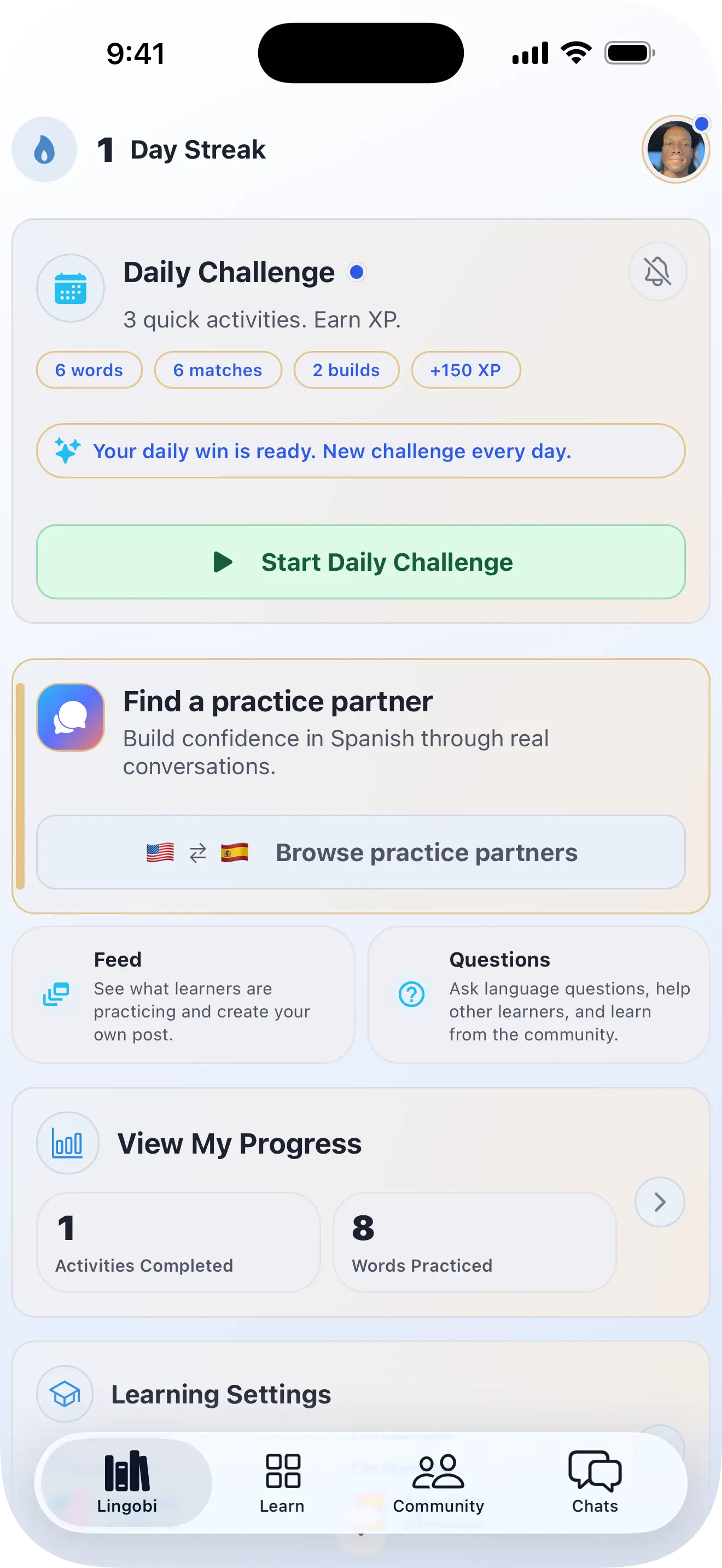
Illustrative app screens. Content varies with your learning language.
Give new words a spoken shape and repeat them inside a phrase you understand.
Learn small combinations that help you remember gender, number, and agreement.
Change the person or object in a familiar sentence before adding another tense.
Rehearse the next turn so a memorized phrase can become a short exchange.
Italian spelling offers useful clues to pronunciation, but English habits can hide important differences. Keep vowel sounds clear, listen for the stressed syllable, and give doubled consonants time. Practice a short phrase at a comfortable pace before increasing speed. When audio is available, compare the written example with what you hear rather than relying on an English-looking pronunciation.
Build grammar around something you want to say. Learn a noun with its article, such as un caffè or una domanda, and keep adjective endings with the whole phrase. Italian verb endings often identify the person, so the subject pronoun is not always needed. Practice a request, a question, and an answer together instead of translating each English word separately.
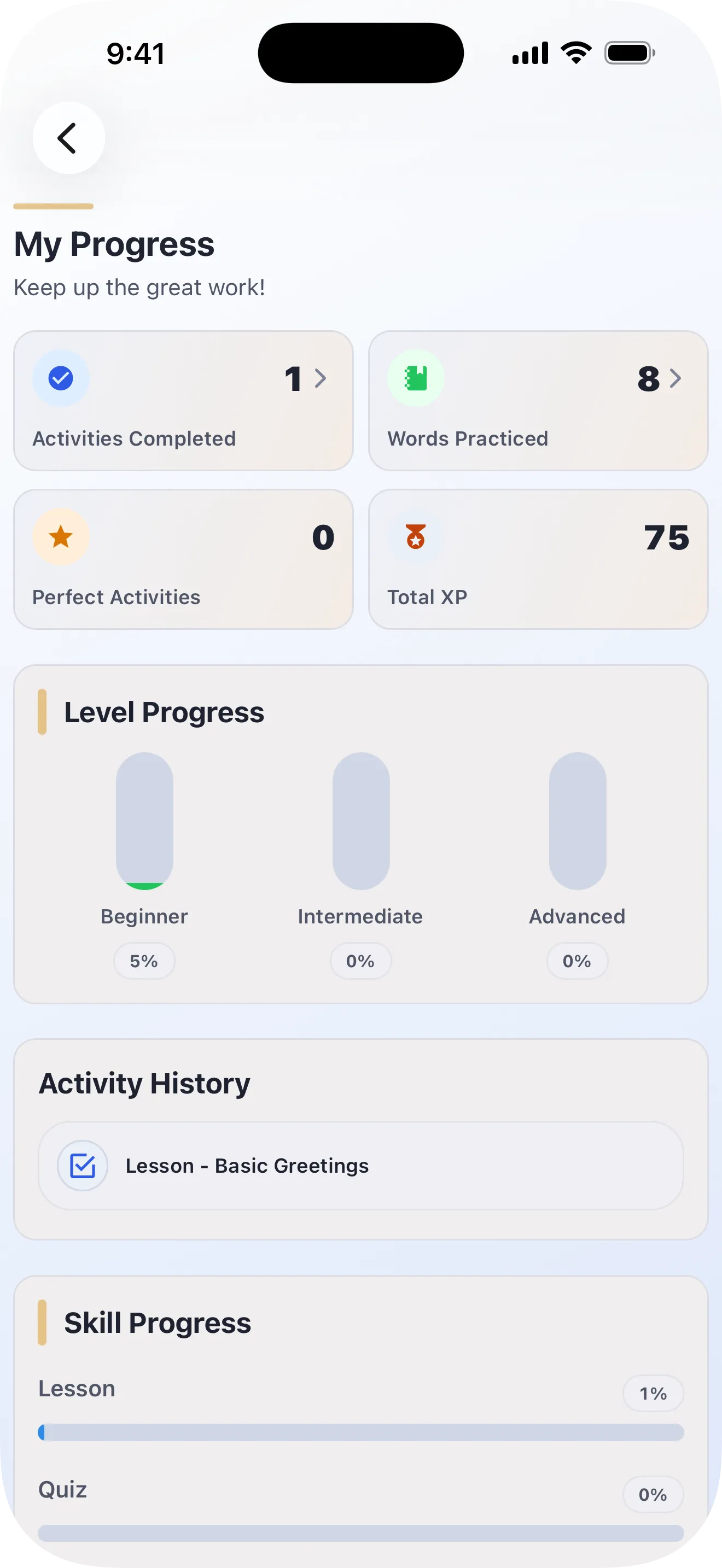
Illustrative app screens. Content varies with your learning language.
Preview the practice available today for this language pair. Try the examples below, then explore more in Lingobi.
Lesson
Word Match
Sentence Builder
Explore the activities available for your language pair in the app and return for fresh daily practice.
Get the AppPlan a small set of expressions around one real goal. Recognizing a word is a first step; recalling it in an answer gives you a different kind of practice. Revisit the same useful language in reading, listening when available, and speaking before expanding your topic.
Read a short expression and check its meaning. Listen when a suitable recording is available, mark the stressed syllable for yourself, and repeat it. Notice the sound of c and g in different letter combinations instead of assuming English pronunciation.
Keep greetings, a polite request, and a clarification phrase together. Add an article whenever you learn a noun. Change one noun in an example and check whether the surrounding words need to change too.
Ask a simple question and prepare an answer with a useful verb. Try the same exchange with a different person, time, or object. Say both turns aloud so you practice listening expectations as well as your own line.
After practice, choose one expression that was difficult to recall. Use it again in a new sentence, then revisit it another day. Increase the length of your response when the shorter exchange feels familiar.
Choose an exchange you would enjoy using. Prepare the opening, one possible reply, and a way to ask for clarification.
Practice a polite request, an item, and a quantity. Listen for a question about what else you would like and prepare a short answer.
Say your name, where you are from, and one interest. Ask the other person a simple question and practice responding to their answer.
Suggest a day, a time, and an activity. Change one detail and repeat the exchange so you can recognize the same pattern later.
Learn to say you did not understand, request repetition, or check a word’s meaning. These expressions give you a useful next step when listening is difficult.
You can begin with the alphabet, everyday vocabulary, and short exchanges. Familiar letters help, but practice their Italian sounds from the start. Choose one situation and learn a few useful phrases before trying to understand a long conversation.
Learn a small amount of grammar inside what you practice saying. Keep articles with nouns and notice the verb ending in each sentence. Use the pattern in another example, then return to the rule when it helps you understand a change.
Listen for word stress, clear vowels, and consonant length. Repeat short examples when audio is available and say the whole phrase aloud. Practice at a pace where you can keep those details, rather than treating speed as the goal.
Choose English as your native language and Italian as your learning language. Explore the activities available for that pair, review vocabulary in context, and use familiar expressions in a short response or conversation. Return to the words you found hard to recall.