Daily Challenge
Preview the practice available today for this language pair. Try the examples below, then explore more in Lingobi.
Lesson
Word Match
Sentence Builder
Japanese for English speakers
Japanese becomes more approachable when you connect its sounds and writing to things you actually want to say. Begin with greetings and small everyday exchanges, then build a routine that combines useful vocabulary, sentence practice, and conversation. You can make progress without waiting to recognize every kanji.
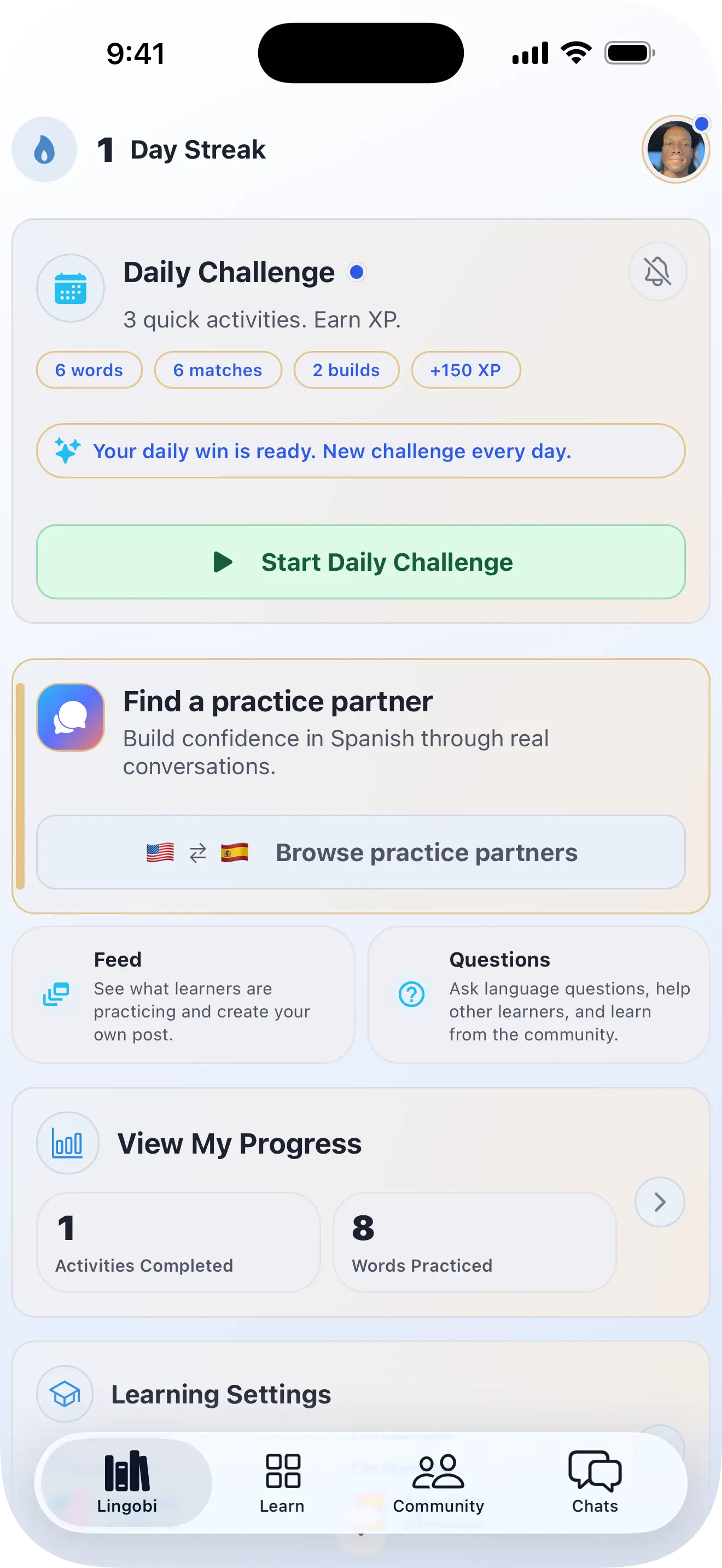
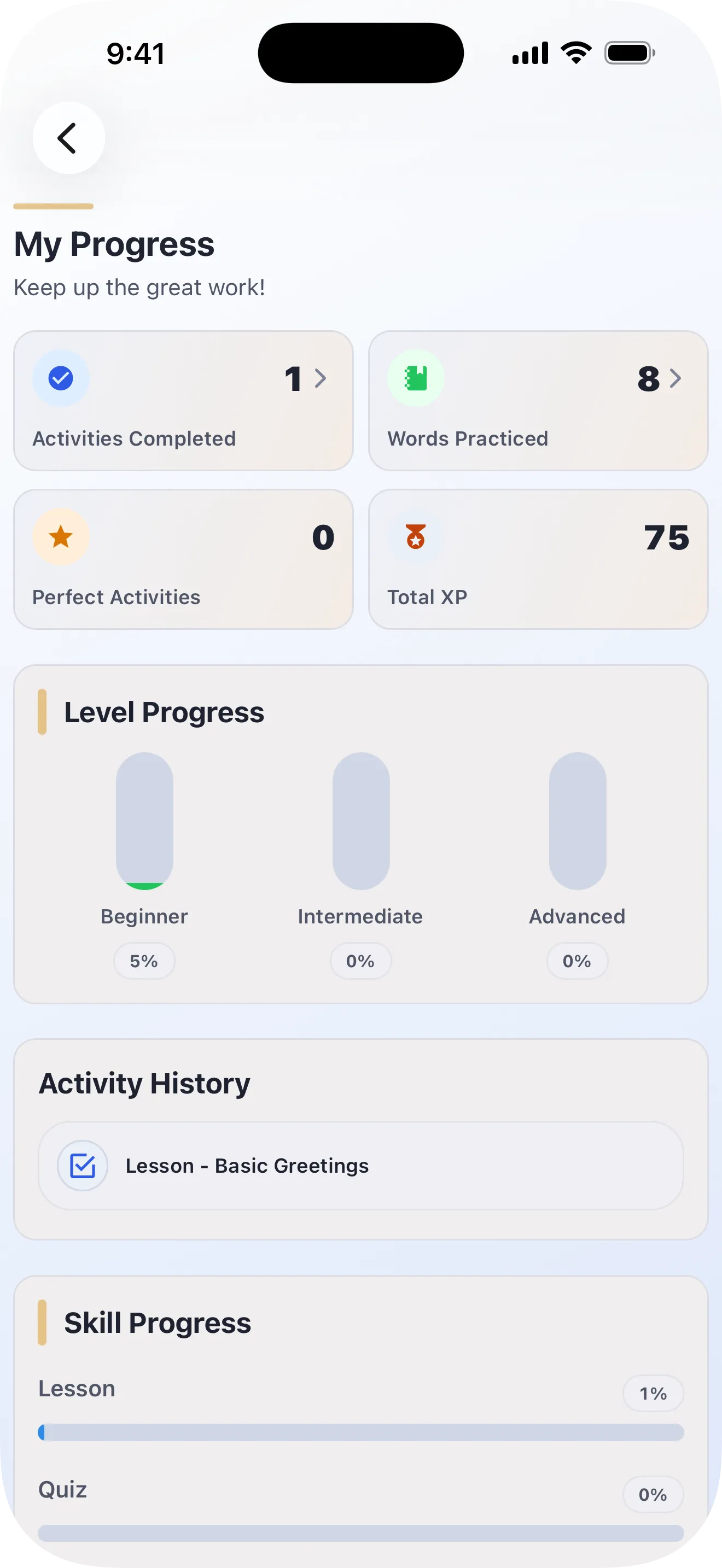
Illustrative app screens. Content varies with your learning language.
Learn a few kana at a time and read them inside useful words.
Listen to a short phrase when audio is available, repeat it, and check the translation.
Practice a sentence frame and change one part, such as the person, place, or object.
Word matching helps you recognize vocabulary.
English often places the verb before its object, while a basic Japanese sentence commonly ends with the verb. Particles such as は, を, and に help signal what each part of the sentence is doing. Learn short complete examples instead of replacing English words one at a time. A sentence-building activity can help you notice the pattern, but say the finished sentence aloud too.
Politeness also changes the form of an expression. Start with a small set of polite phrases suitable for introductions, shops, and asking for help, then notice how familiar conversation differs. When you listen, pay attention to vowel length and the rhythm of the whole phrase. A readable translation helps you understand the meaning; repeated listening and speaking help you recognize it in conversation.
Illustrative app screens. Content varies with your learning language.
Preview the practice available today for this language pair. Try the examples below, then explore more in Lingobi.
Lesson
Word Match
Sentence Builder
Explore the activities available for your language pair in the app and return for fresh daily practice.
Get the AppChoose a small goal for the week, such as introducing yourself or ordering a drink. Repeat the words for that goal in several activities, then try a short response without looking at the translation. The aim is to recall a useful phrase when you need it.
Learn a few kana at a time and read them inside useful words. Hiragana and katakana represent sounds; kanji carries meaning and has readings that depend on the word. Use romanization as temporary support, while gradually returning to Japanese writing.
Listen to a short phrase when audio is available, repeat it, and check the translation. Distinguish short and long vowels and listen to the phrase’s rhythm. Recognition becomes easier when you revisit a small set of examples.
Practice a sentence frame and change one part, such as the person, place, or object. Check the particle and verb ending after each change. Build meaning first, then use the English translation to confirm what your Japanese sentence says.
Word matching helps you recognize vocabulary. Take the next step by recalling the word in a full answer, writing a short message, or trying a conversation prompt. Review the expressions you could not recall and use them again next time.
Try one short exchange at a time. Use a familiar phrase, change one detail, and practice answering a simple follow-up question.
Practice a name, where you are from, and one interest. Ask one simple question in return so the exchange becomes a conversation.
Rehearse a drink or food order, a quantity, and a polite request. Change the item while keeping the same useful sentence frame.
Learn how to say you do not understand and ask someone to repeat. These phrases let you keep practicing when you miss a word.
Describe one activity and one plan. Reuse familiar verbs and time words before adding a longer explanation.
No. Start with short spoken phrases and basic kana while gradually learning kanji in useful words. Reading and speaking can develop together; you do not need to finish one before starting the other.
Romaji can help you get started, but relying on it makes Japanese text harder to recognize later. Learn kana gradually and compare the written word with its sound whenever you have a suitable example.
Choose Japanese in the app and explore the activities available for your language pair. Combine vocabulary practice with sentence building and conversation, and revisit expressions you want to recall more easily.
Reduce the goal to one useful exchange. Prepare a greeting, a short answer, and a request to repeat. Afterward, review one expression you needed rather than trying to learn every unfamiliar word at once.