Korean for English speakers

Learn Korean with Hangul and small everyday conversations

Give your first Korean phrases a job: introducing yourself, ordering a drink, or checking where to meet. Learn to read the Hangul in those expressions and prepare a possible reply. You can build a useful exchange with a small vocabulary while gradually understanding how sounds, particles, and sentence endings work together.

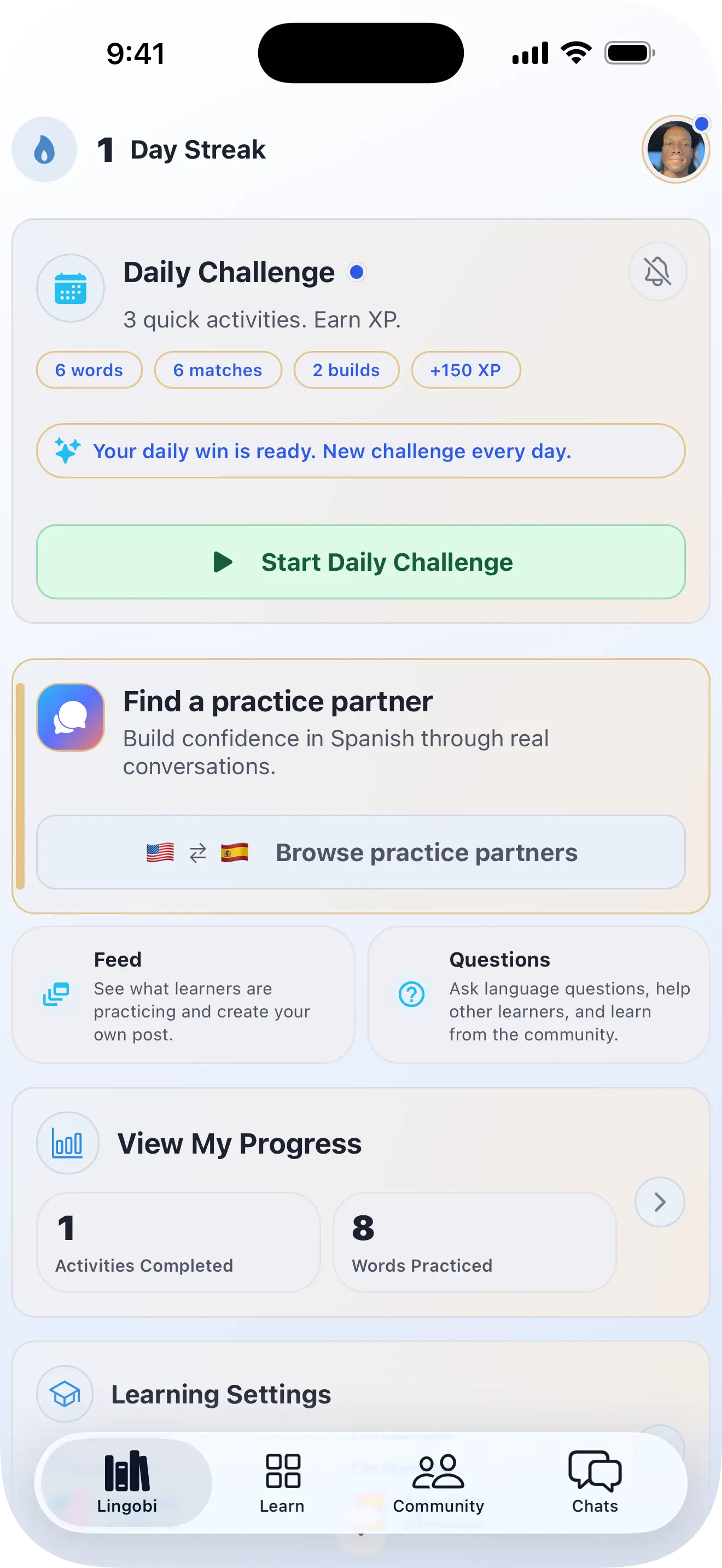
Lingobi app welcome screen

Illustrative app screens. Content varies with your learning language.

Read the words you want to use

Recognize Hangul letters inside the syllable blocks of familiar expressions.

Listen to sounds in context

Compare vowels, consonants, and syllable connections in a short phrase.

Keep particles and endings with the phrase

Learn a useful sentence with its meaning and the person you would say it to.

Practice the next turn

Prepare an answer, a confirmation, or a request to repeat after your opening.

Connect readable letters with a complete Korean sentence

Hangul is an alphabet whose consonant and vowel letters are arranged in syllable blocks. Learn to identify the parts of a block rather than memorize it as an indivisible picture. Romanization can help at first, but familiar English letters do not capture every Korean contrast. Notice vowel differences and the plain, aspirated, and tense consonants. A final consonant, or batchim, can sound different in connected speech, so compare a short written phrase with suitable audio when it is available.

In many basic Korean sentences, the predicate comes at the end, unlike the usual English placement of a verb before its object. Learn nouns with their particles in examples: 은/는 can mark a topic, while 이/가 mark a subject, and their uses are not interchangeable in every context. Start with complete polite expressions, including common -아요/-어요 forms. 커피 한 잔 주세요 asks for one cup of coffee. Change the item or quantity and check the whole phrase instead of translating each English word separately.

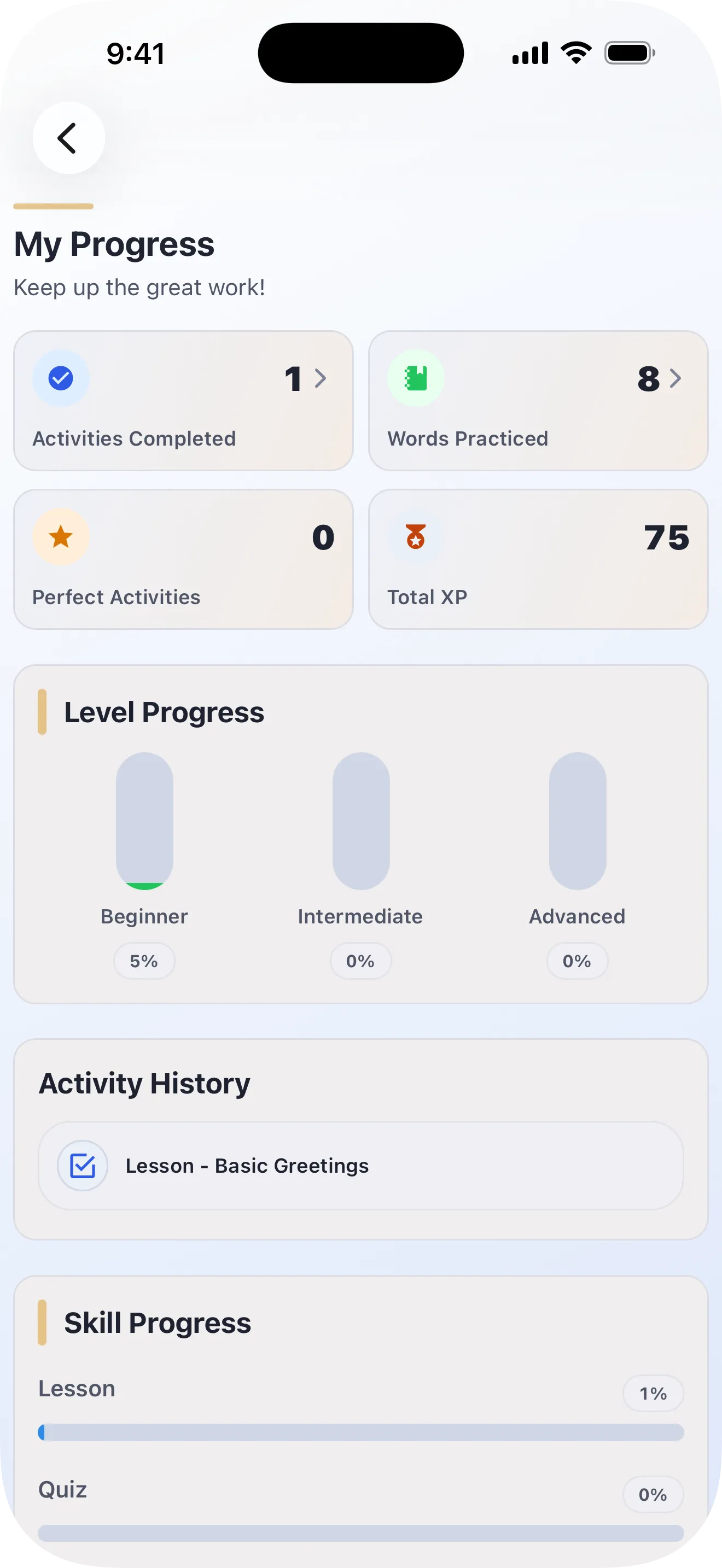
Lingobi progress screen

Illustrative app screens. Content varies with your learning language.

Daily Challenge Food & Drink Today's preview

Daily Challenge

Preview the practice available today for this language pair. Try the examples below, then explore more in Lingobi.

Lesson

편하게 드세요 소금 좀 건네 주세요

Word Match

Help yourself → 편하게 드세요
Pass the salt → 소금 좀 건네 주세요

Sentence Builder

편하게 드세요.

Make every day a practice day.

Explore the activities available for your language pair in the app and return for fresh daily practice.

Get the App

Build a routine around reading and answering one exchange

Choose a situation and a handful of expressions for the week. Give reading, listening when audio is available, and recalling a reply their own turns. Reuse the same phrases so a new sound or ending has a meaning you already understand.

  1. 1. Read one phrase in Hangul

    Check the meaning and identify the letters inside each syllable block. Use romanization as a temporary aid rather than applying English pronunciation rules. Practice a suitable spoken example when one is available.

  2. 2. Notice the particle and ending

    Keep the noun with its particle and the predicate with its ending. Check who the phrase is addressed to and what it does in the conversation. Learn the complete example before trying to change its form.

  3. 3. Swap one detail and prepare a reply

    Change a drink, a quantity, or a meeting time. Check the counter, particle, and ending in the new phrase. Say a likely answer and a confirmation as well as your question.

  4. 4. Review where the exchange stopped

    Choose one sound, word, or ending you could not recognize. Return to a short example another day. Expand the conversation when the familiar question and reply are easier to recall.

Choose a task for your first Korean exchange

Work on a question, a likely answer, and a way to continue. Add one new detail when the shorter exchange is familiar.

Introduce yourself politely

Say your name and one detail about yourself. Learn a suitable reply to an introduction and keep the level of politeness consistent.

Order a drink

Ask for a drink and a quantity. Learn a number with the counter used in that phrase, then prepare to confirm your choice.

Arrange a meeting

Suggest a time and place, then practice accepting or changing one detail. Listen for the information needed to confirm the plan.

Check your understanding

Ask someone to repeat or speak more slowly. Confirm the part you understood before returning to the missing information.

Questions about learning Korean from English

Should I learn Hangul before speaking Korean?

Learn Hangul alongside your first useful phrases. Reading their letters helps you rely less on approximate English spellings. You can practice a short exchange while gradually improving letter recognition and pronunciation.

Why can a Korean word sound different from its spelling?

Letters have sound patterns that depend on their position and neighboring sounds. Pay attention to final consonants and connections between syllables. Compare a brief written expression with reliable audio when available, then practice it as a whole.

Which level of politeness should I practice first?

Common polite expressions are a useful starting point for many everyday interactions. Learn the ending with the complete example and its situation. Other forms may be appropriate depending on the relationship and setting, so avoid changing endings without checking their use.

How can I practice Korean in Lingobi?

Choose English as your native language and Korean as your learning language. Explore the activities available for that pair and reuse familiar expressions in a brief reply or conversation. Review the sounds, particles, or endings that made you hesitate.

Make room for a short Korean conversation

Explore Lingobi for English and Korean. Use the practice available for your pair and return to a small exchange you want to read, understand, and use.