Daily Challenge
Preview the practice available today for this language pair. Try the examples below, then explore more in Lingobi.
Lesson
Word Match
Sentence Builder
Portuguese for English speakers
Begin with a request you could use today: ordering a drink, asking a price, or arranging a meeting. Learn the question and a likely answer together. Connect the written words to their spoken rhythm, then reuse the same short exchange with a new item or person.
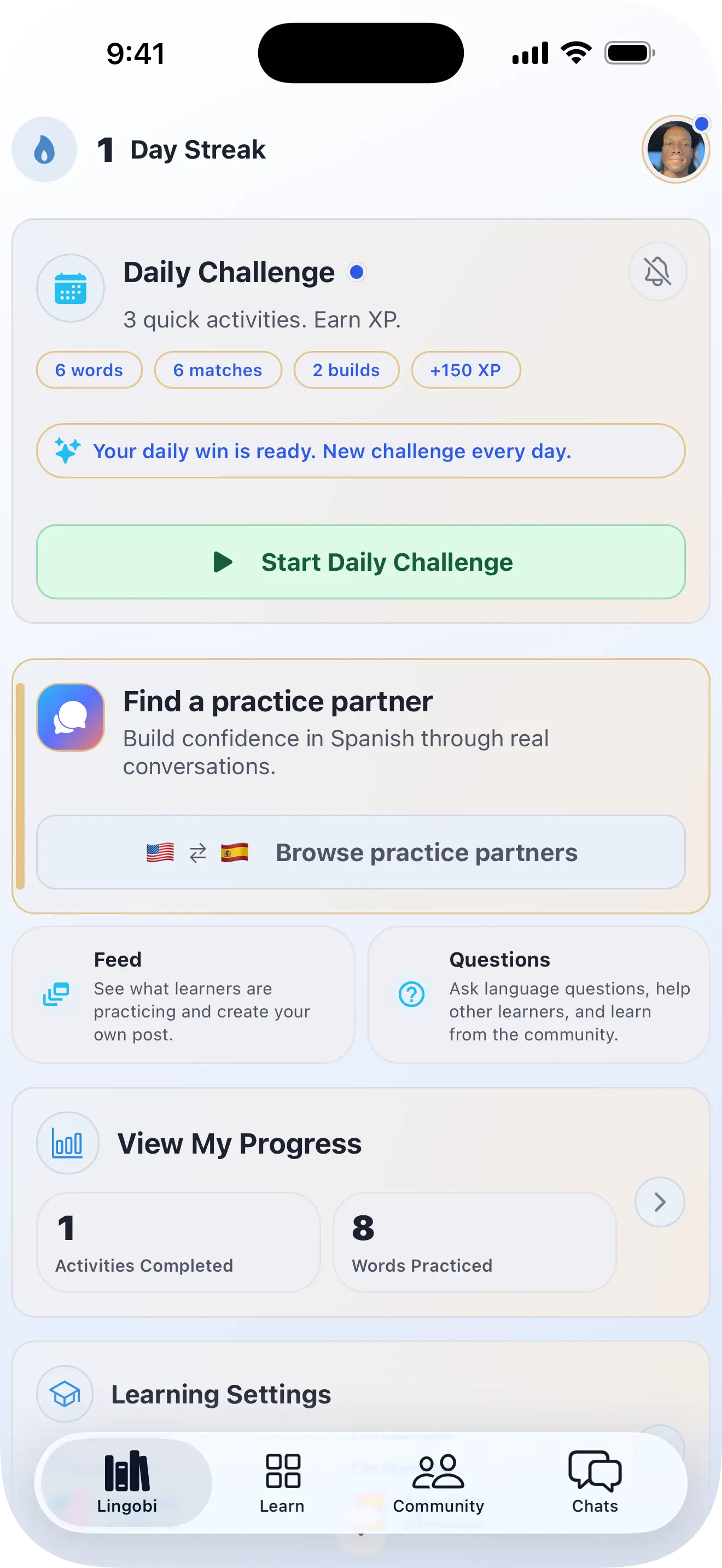
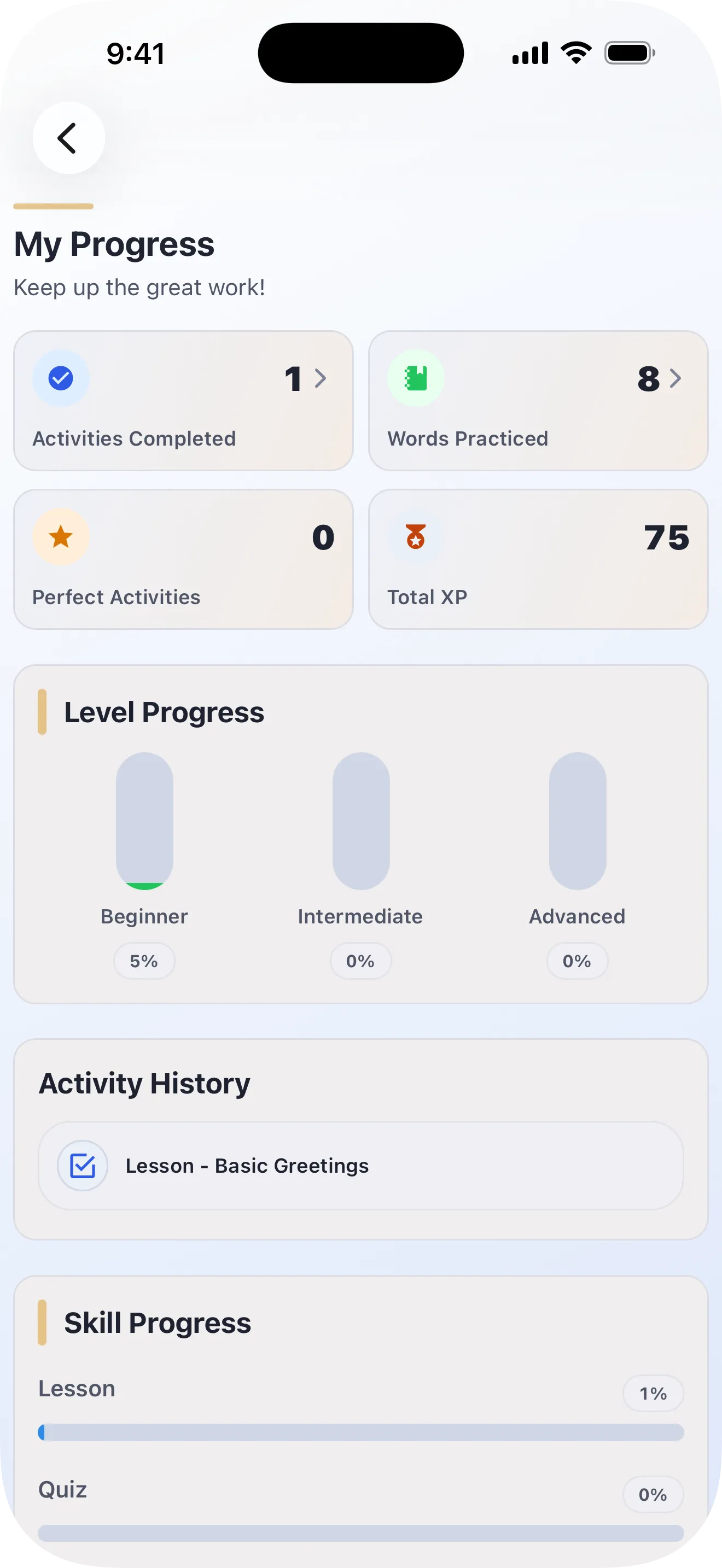
Illustrative app screens. Content varies with your learning language.
Study the sound and rhythm of words inside an expression you understand.
Compare singular and plural phrases with their agreement.
Notice the person and form of address in a complete response.
Practice confirming a choice or asking for clarification after your question.
Notice the nasal sounds in pão and não, word stress, and the letter combinations nh and lh. Familiar letters do not always have their English values. Pronunciation varies between Brazil, Portugal, and other Portuguese-speaking regions, especially in unstressed vowels and some consonants. Start with a consistent spoken model when suitable audio is available, then compare other voices without treating every difference as a mistake.
Keep articles with nouns: a casa becomes as casas in the plural. English the does not encode the gender and number needed for Portuguese agreement. Learn a verb with the person in a meaningful reply. Você uses third-person verb forms, while the use of tu and its forms varies by region and situation. Save complete examples rather than translating English you into one universal expression.
Illustrative app screens. Content varies with your learning language.
Preview the practice available today for this language pair. Try the examples below, then explore more in Lingobi.
Lesson
Word Match
Sentence Builder
Explore the activities available for your language pair in the app and return for fresh daily practice.
Get the AppChoose one situation for the week. Reuse a few expressions in reading, listening when audio is available, and answering from memory.
Check meaning and stress, then repeat a suitable spoken example. Keep nasal vowels and connected words inside the whole phrase.
Compare a singular phrase with its plural. Notice articles and adjective agreement when you change the number.
Check the verb and form of address in the new example. Prepare a likely answer as well as the question.
Return to one sound, word, or response another day. Add detail when the familiar exchange becomes easier to recall.
Practice a question, an answer, and one way to continue before adding more vocabulary.
Use um café, por favor as a short request, then practice confirming the item and quantity.
Learn the price question with numbers you can recognize in the answer.
Suggest a time and place, then accept or change one detail.
Prepare a polite request to repeat and confirm the information you understood.
Choose a model suited to the people or places you want to communicate with. Many written structures are shared, while sounds and some expressions differ. These tips do not imply that every practice activity offers a choice of variety.
Learn a word with its meaning and a reliable spoken example when available. Compare short expressions containing pão or não, then repeat the phrase. Avoid simply adding an English n after every vowel.
Usage depends on region, relationship, and setting. Learn the address form with its verb and context. Você normally takes third-person forms; do not assume every English you has the same Portuguese equivalent.
Choose English as your native language and Portuguese as your learning language. Explore the activities available for that pair and reuse familiar words in short replies. Review the sounds or forms that interrupted your response.