Daily Challenge
Preview the practice available today for this language pair. Try the examples below, then explore more in Lingobi.
Lesson
Word Match
Sentence Builder
Hindi for English speakers
Begin with a greeting and a small task, such as asking a price or arranging a meeting. Read a short expression in Devanagari, learn what it means, and prepare an answer. Connect script and sound to a conversation you can actually continue.
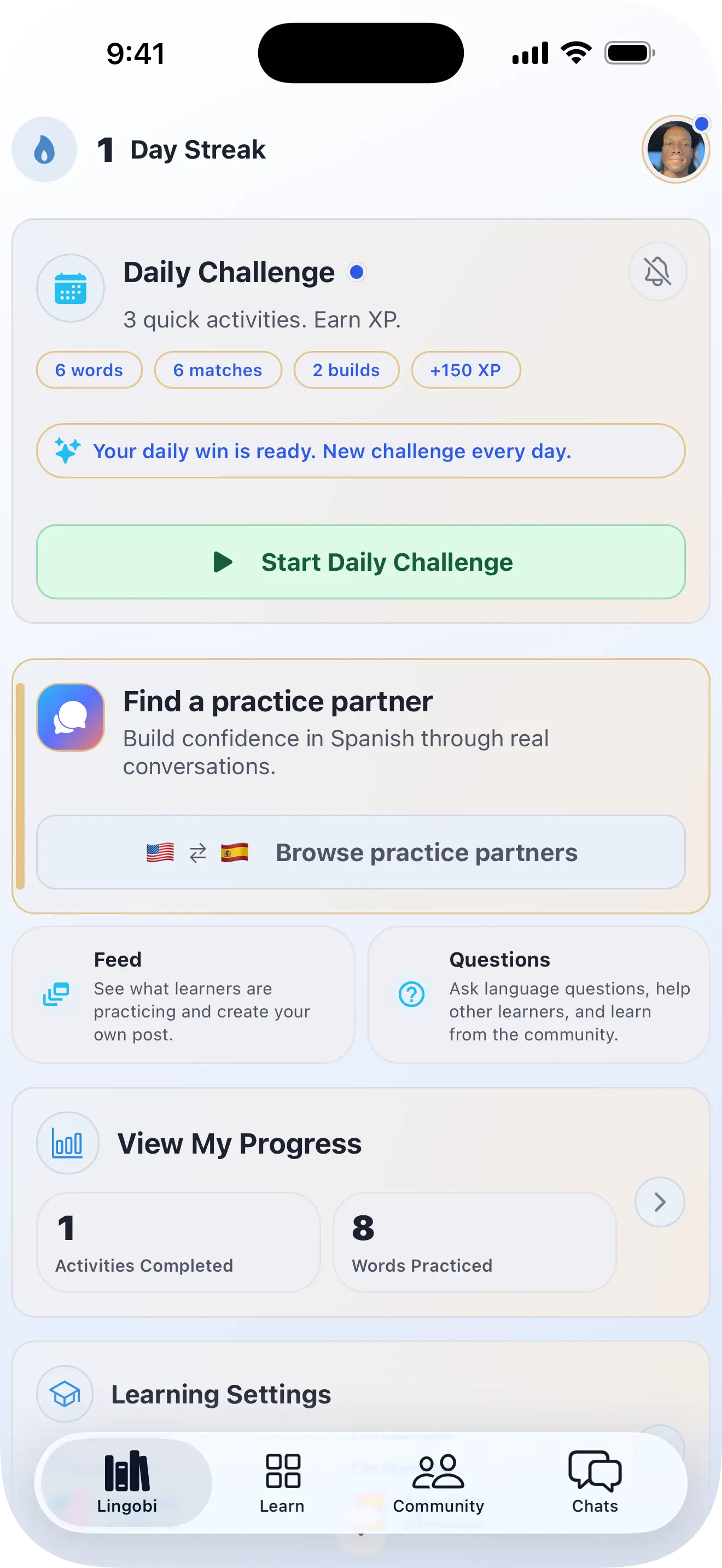
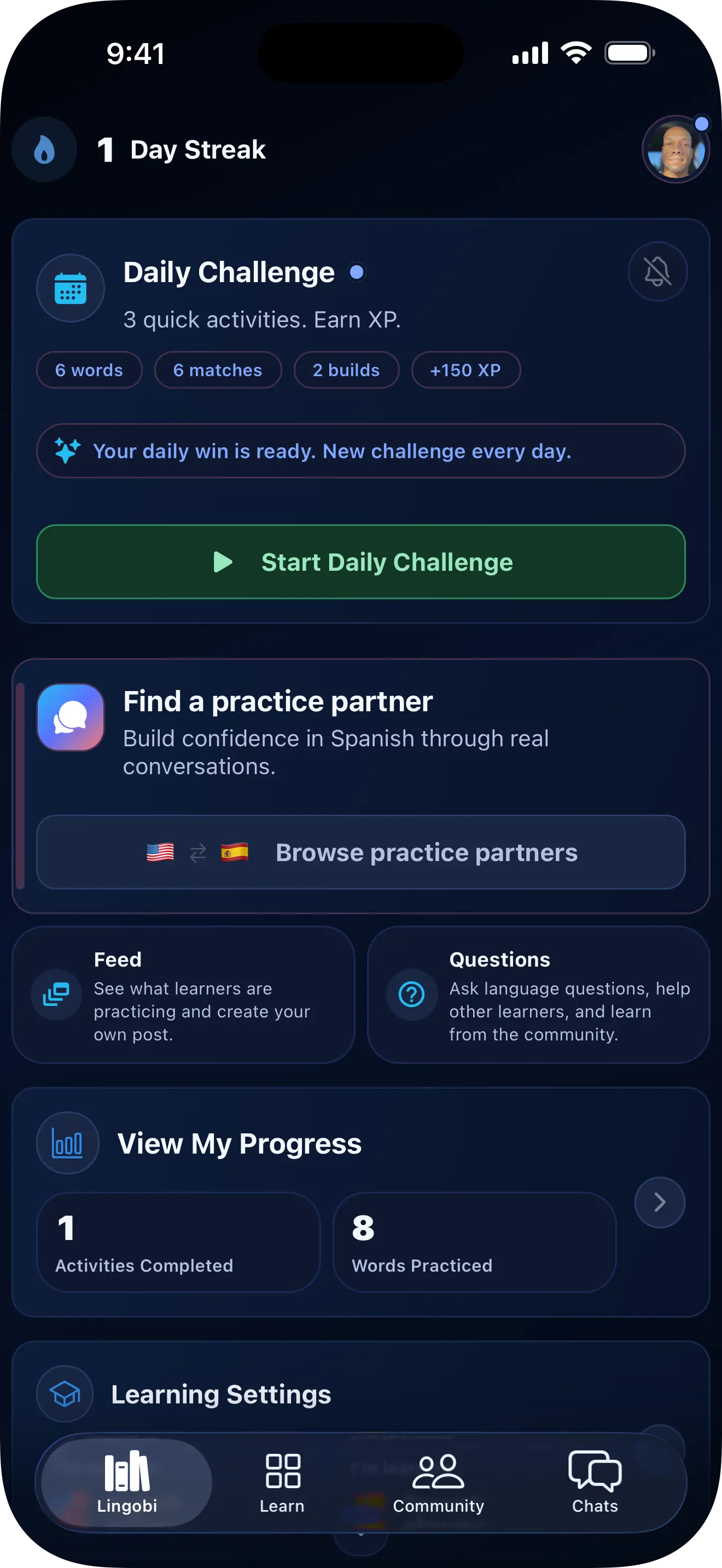
Illustrative app screens. Content varies with your learning language.
Connect the written combination to its spoken order.
Practice tongue position and aspiration with a suitable model.
Compare the noun and forms that agree with it.
Learn address and verb form in the same exchange.
Read consonants with their vowel signs: क, कि and की combine the same consonant with different vowels. In कि, the sign appears before the consonant but the vowel is spoken after it. The inherent अ is not pronounced everywhere, so check real words rather than adding a vowel after every consonant. With suitable audio when available, compare dental त and retroflex ट, then unaspirated क and aspirated ख. These contrasts can distinguish words; they are more than different spellings of English t or k.
Hindi commonly places the verb after the object and uses postpositions, such as घर में (in the house), after a noun. Do not copy English word order mechanically. Nouns have grammatical gender: घर is masculine and किताब feminine; compare अच्छा घर with अच्छी किताब. Learn the noun with an agreeing phrase because English does not give you its Hindi gender. Use आप with appropriate respectful verb forms when the setting calls for them, rather than treating every English you as the same Hindi expression.
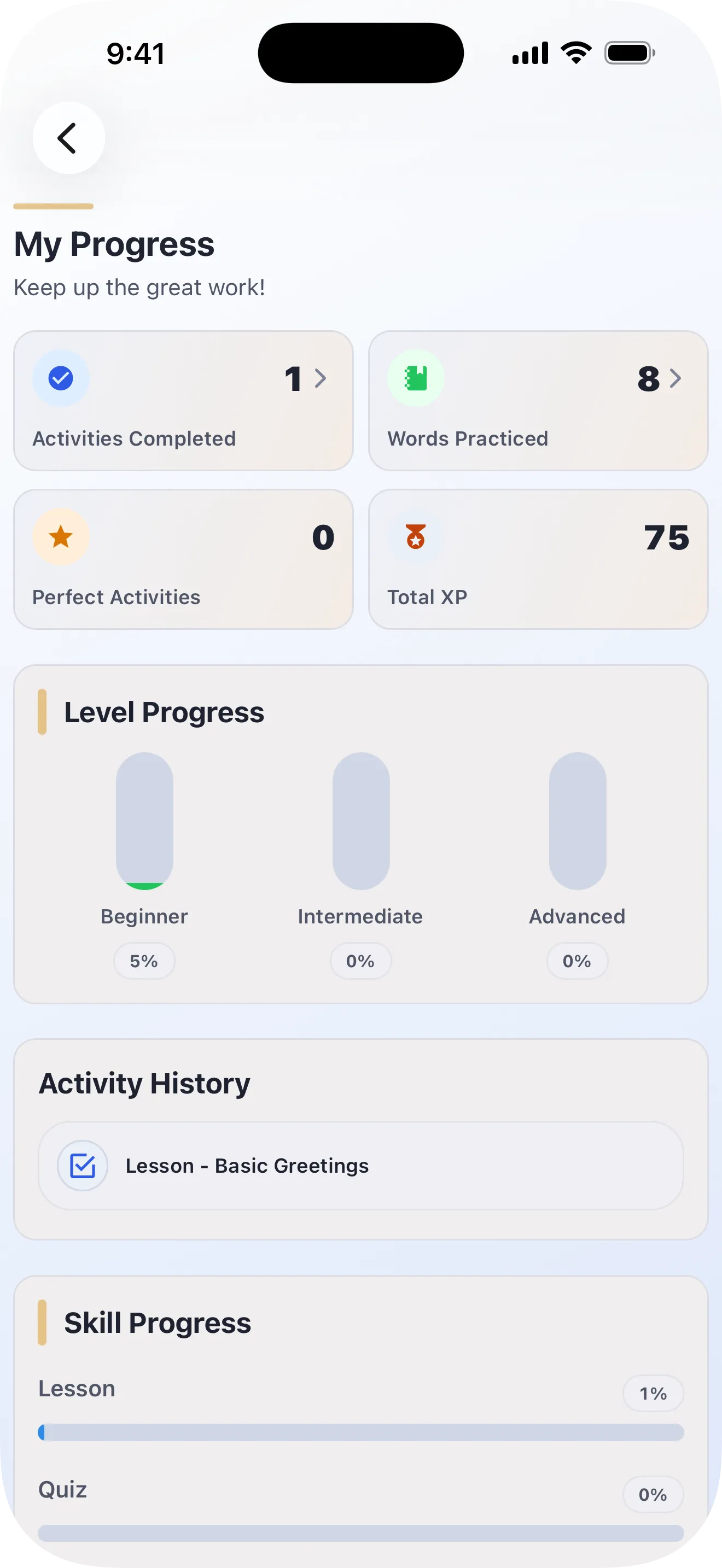
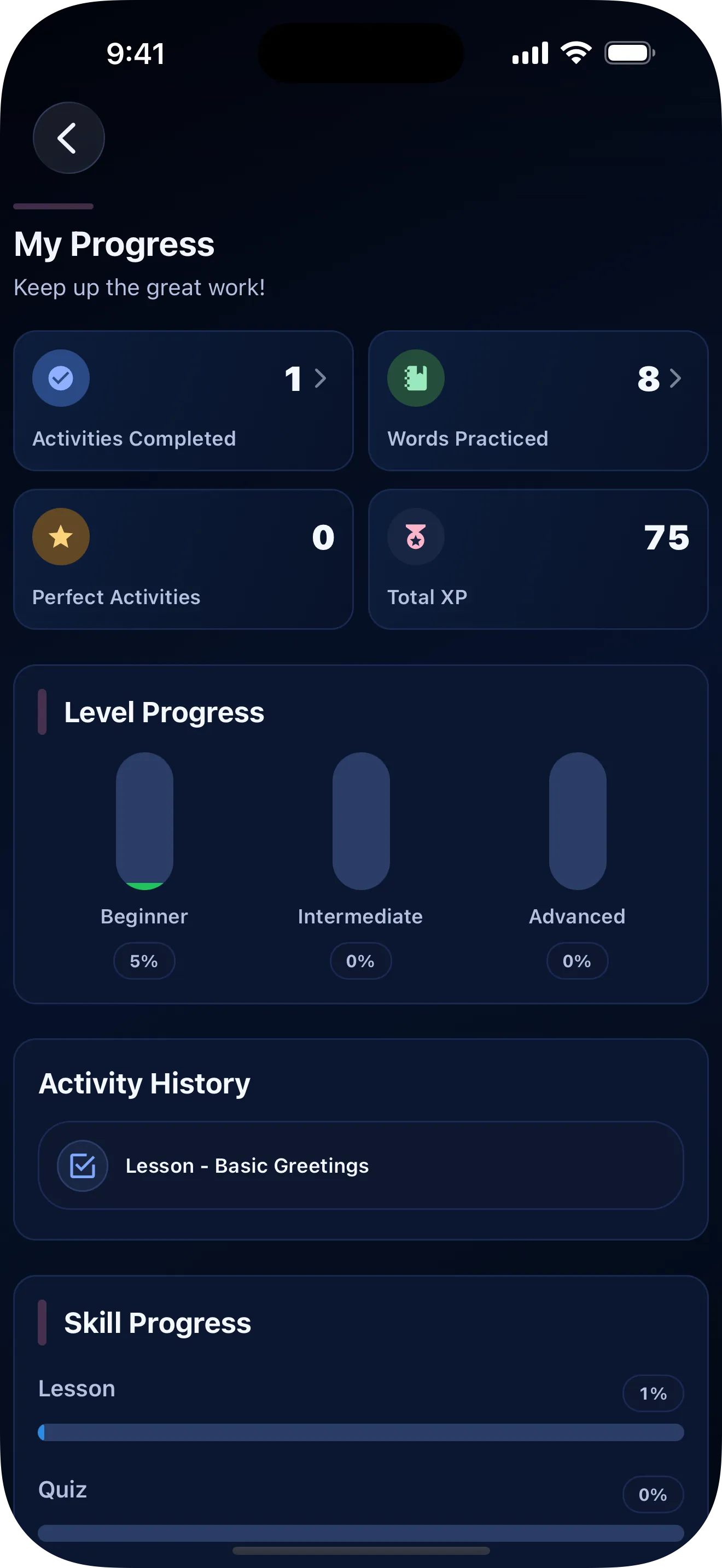
Illustrative app screens. Content varies with your learning language.
Preview the practice available today for this language pair. Try the examples below, then explore more in Lingobi.
Lesson
Word Match
Sentence Builder
Explore the activities available for your language pair in the app and return for fresh daily practice.
Get the AppChoose one situation and revisit a few expressions on different days.
Identify its consonants and vowel signs with the meaning.
Use suitable audio when available; compare a single consonant contrast.
Notice verb position, postpositions, gender and address.
Change one detail and review the form that slowed your reply.
Learn a question with an answer and one way to continue.
Use नमस्ते, then learn a name question and its reply.
Recognize a location expression such as घर में before changing the place.
Practice the question with numbers you can recognize in the answer.
Suggest a time and prepare a polite acceptance or alternative.
They can help briefly, but spellings vary and may hide sound contrasts. Learn Devanagari alongside useful words rather than postponing it indefinitely.
It is an aspirated consonant: the release includes a noticeable breath. Compare it with क in a reliable spoken example when available, without inserting a separate vowel.
Save a noun with an agreeing expression, such as अच्छी किताब. Change one detail and check which forms change; word meaning alone is not a reliable gender rule.
Choose English as your native language and Hindi as your learning language. Explore the available activities for the pair and review expressions you could not recall.