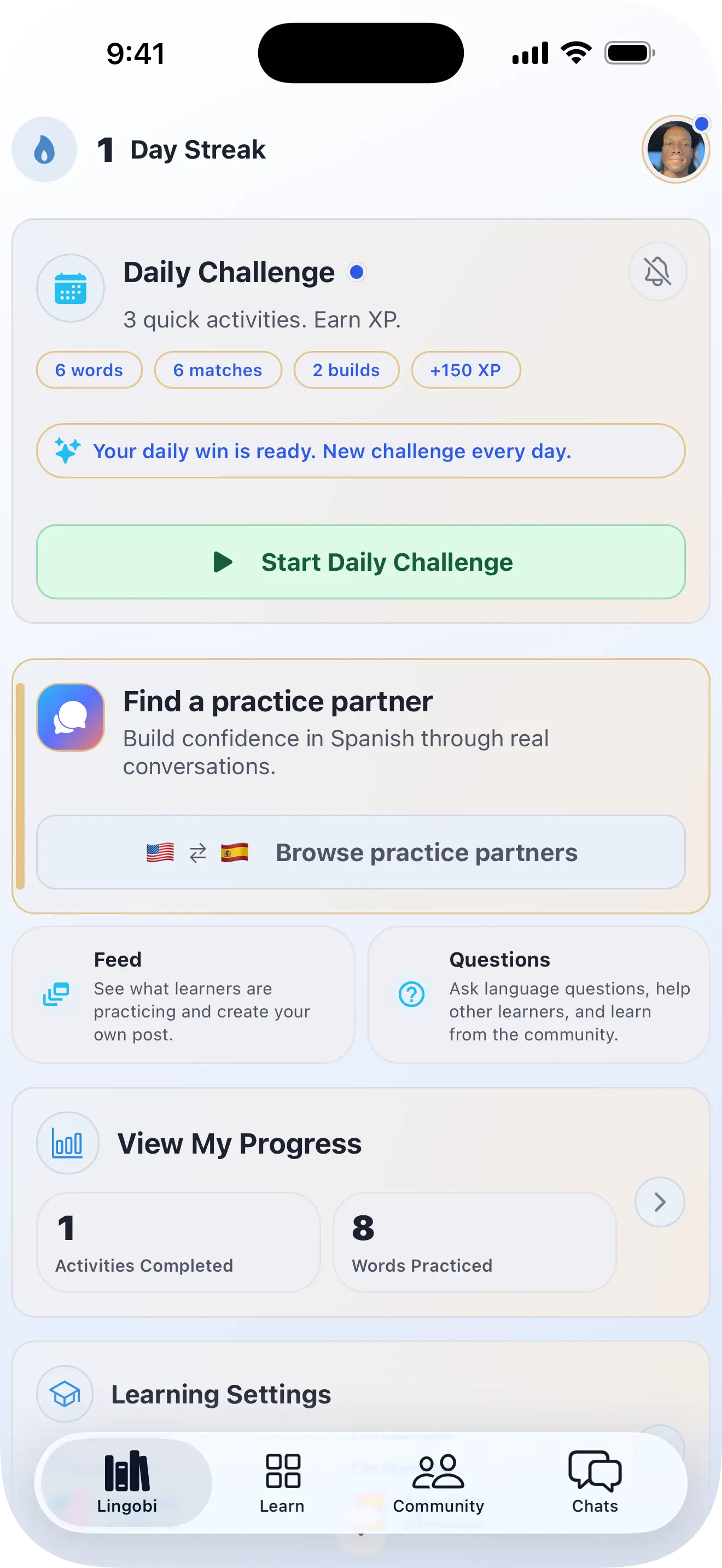

Daily Challenge
Preview the practice available today for this language pair. Try the examples below, then explore more in Lingobi.
Lesson
Word Match
Sentence Builder
Chinese for English speakers
Start with a small exchange: ordering a drink, checking a price, or finding a place. This guide focuses on Mandarin Chinese. Learn what a phrase means, how its syllables sound, and what a possible reply might be. Add a few useful characters alongside speaking practice, so reading and conversation support each other from the beginning.
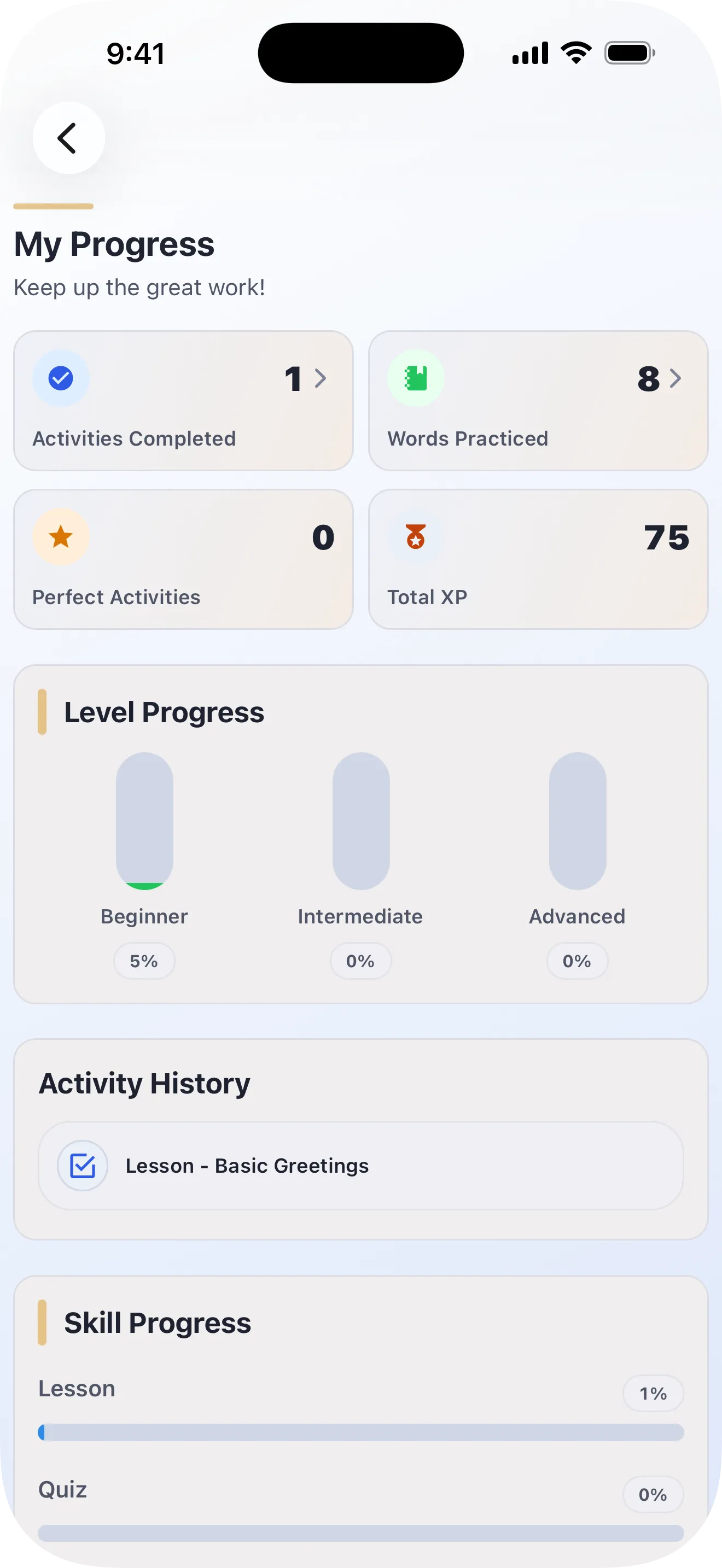
Illustrative app screens. Content varies with your learning language.
Practice syllables inside short expressions and notice how neighboring sounds fit together.
Recognize the written words from an exchange you can already understand.
Keep a number, its measure word, and its noun together in a useful example.
Listen for the price, place, or choice you need to continue the exchange.
Pinyin uses familiar letters to represent Mandarin pronunciation, but it does not follow English spelling rules. Learn a syllable with its tone rather than adding pitch later. Mandarin distinguishes four main tones and a neutral tone; pitch can distinguish words, while tone patterns can change in connected speech. When suitable audio is available, listen to a short expression, repeat it, and compare the whole phrase as well as its individual syllables.
Mandarin verbs do not take English-style endings for person or tense. Pay attention to word order, time expressions, and how a sentence describes an event instead of translating an English ending. Learn quantity phrases as a unit: 一杯茶 means a cup of tea, with 杯 indicating the cup measure. Connect characters to words you already understand, then practice a question, an answer, and a way to ask for repetition.
Illustrative app screens. Content varies with your learning language.
Preview the practice available today for this language pair. Try the examples below, then explore more in Lingobi.
Lesson
Word Match
Sentence Builder
Explore the activities available for your language pair in the app and return for fresh daily practice.
Get the AppPick one task for the week and a handful of words that belong to it. Recall their meaning, recognize their written form, and use them in a response. A longer word list is less useful if you cannot identify the information needed in the next turn.
Check the meaning and the Mandarin pronunciation. Use pinyin as a pronunciation aid when available, with attention to tones. Repeat a suitable spoken example before trying the phrase from memory.
Choose words from your exchange and recognize their characters together. Notice recurring components without assuming every character reveals its meaning or pronunciation. Review the word again inside its sentence.
Swap an item, a quantity, or a time expression. Check word order and any measure word in the new example. Prepare a possible reply so the change becomes part of an exchange.
After practicing, choose one sound, number, or character you did not recognize. Review a short example and try it again another day. Add more detail when the familiar question and reply become easier to recall.
Choose a task with an answer you can recognize. Reuse the same pattern with a different item, number, or location.
Name what you want and how much. Prepare a response to a question about your choice, then change the drink in the same example.
Ask how much something costs and practice recognizing numbers in the answer. Confirm the quantity before adding more detail.
Ask where a station, shop, or meeting point is. Learn a few location words with the question so the answer has something familiar.
Practice asking someone to repeat or speak more slowly. Say what you understood and check the part you missed.
The pronunciation and grammar advice here focuses on Mandarin. Chinese includes other varieties with different spoken forms. Use Mandarin examples when practicing the pinyin and tone patterns described on this page.
Yes. Begin with a few meaningful phrases and learn to recognize their characters alongside them. Pinyin can help you study pronunciation, but its letters need their own sound values and tone marks. Gradually connect the spoken words with their written forms.
Learn the tone when you learn a word. Use a reliable spoken example when available, repeat a short expression, and compare similar syllables. Practice words together as well as separately because pronunciation can change with the surrounding tones.
Choose English as your native language and Chinese as your learning language. Explore the activities available for that pair and reuse familiar words in a brief reply or conversation. Review the sounds, characters, or numbers that made you hesitate.